

Pros – Strong smooth diesel performance, high-end comfort and tech, true full-time 4×4 capability and versatility
Cons – Premium price tag, 21-inch tires aren’t that desirable, aggressive fuel economy when compared to smaller engines
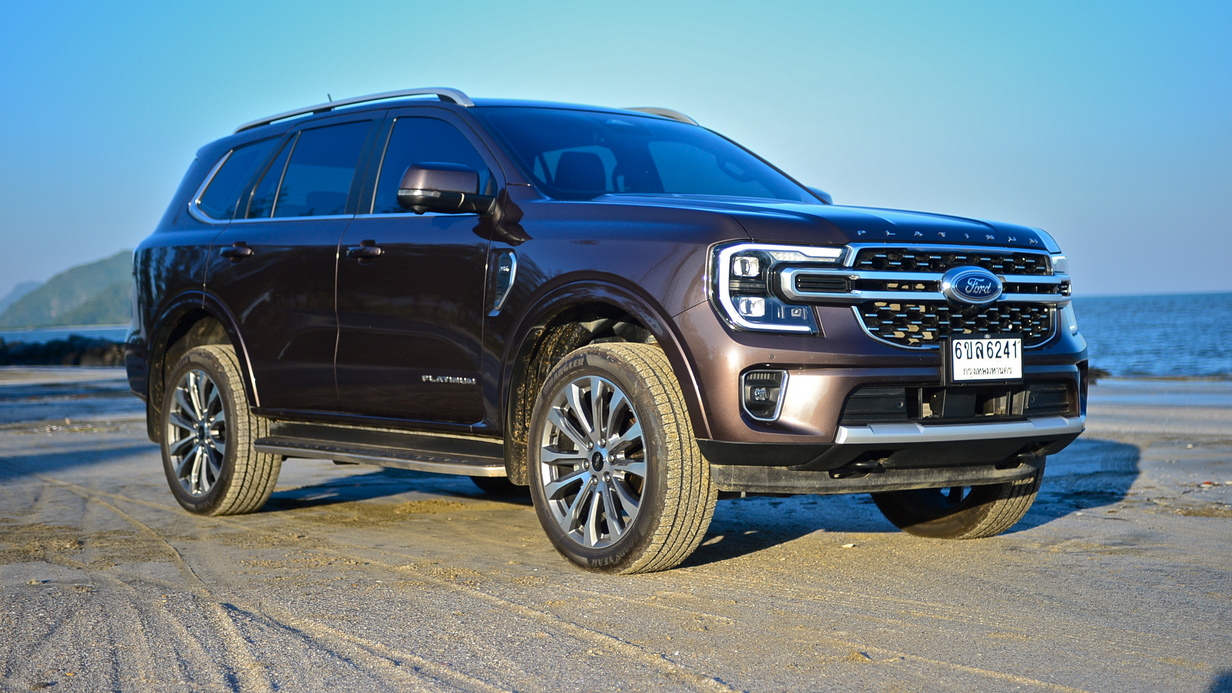
The Ford Everest Platinum establishes itself as one of the most technically sophisticated and dynamically resolved pickup-based passenger vehicles currently available in Thailand. Underpinned by the Ranger’s robust ladder-frame platform, this range-topping derivative blends genuine mechanical muscle with an on-road refinement that belies its utilitarian origins.


Powertrain & Performance
Central to the Everest Platinum’s appeal is its 3.0-litre V6 turbo-diesel, an increasingly rare proposition in a segment dominated by four-cylinder units.
The 60-degree DOHC 24-valve powerplant pumps out as much as 184 kW (250 PS) at 3,250 rpm, complemented by a whopping 600 Nm torque plateau spanning 1,750 to 2,250 rpm. The power and torque output from this engine is the highest in the Thai Pickup Passenger Vehicle (PPV) market that also includes the Toyota Fortuner, Mitsubishi Pajero Sport and Nissan Terra.

Power is channeled through a 10-speed automatic transmission to a full-time four-wheel-drive system, incorporating an Active Center Differential and a locking rear differential.
In operation, torque delivery is both immediate and sustained, lending the Everest an effortless stride from low engine speeds through the mid-range.

The engine’s demeanour is distinctly civilised: diesel combustion noise is well muted, and progress builds in a smooth, linear fashion, making overtaking manoeuvres and steep gradients feel entirely unstrained.
Selectable drive modes — Normal, Eco, Tow/Haul, Slippery, Mud/Ruts and Sand — recalibrate throttle response, traction control and shift strategy to suit prevailing conditions. This breadth of configurability underlines the Platinum’s dual-use remit, allowing it to function convincingly as both a long-distance tourer and a genuine off-road tool.

And apart from the usual 2H, 4H and 4L choices, there’s also 4A which is fully automatic, switching from two- to four-wheel drive when necessary.
Acceleration & Fuel Consumption
Independent testing confirms the Everest Platinum’s real-world credentials. The 10-speed automatic moves seamlessly through its ratios, delivering assured mid-range acceleration rather than outright sprinting pace — entirely in keeping with the vehicle’s remit.
Fuel efficiency, meanwhile, remains respectable for a full-time 4WD SUV of this mass and frontal area. At a steady 110km/h, consumption of approximately 9km/l (at the rate I was pushing the accelerator) was the norm, underscoring the drivetrain’s efficiency when driven with restraint.
Meanwhile, the average fuel consumption of the Everest Platinum is claimed at 8.5 liters per 100km (11.7km/l).

Chassis, Ride & Handling
Despite its rugged underpinnings, the Everest Platinum resists the crude, heavy-handed dynamics often associated with ladder-frame SUVs.
Suspension tuning strikes an effective compromise between body control and compliance: the vehicle remains composed over broken surfaces while delivering a settled, comfortable ride at cruising speeds. Steering response is accurately weighted and reassuringly consistent, providing sufficient precision on fast sweepers while remaining light enough for urban manoeuvring. The overall impression is of a chassis that disguises its size with notable success — a clear credit to Ford’s calibration work.

Interior & Equipment
Inside, the Everest Platinum distances itself from traditional PPV austerity. High-grade materials, leather-trimmed heated and ventilated seats, a panoramic glass roof, and a Bang & Olufsen premium audio system elevate the cabin ambience into near-premium territory.


A comprehensive suite of active safety and driver-assistance systems further enhances its appeal. Ergonomics are well judged, material quality is competitive at the segment’s upper end, and the design language deftly balances rugged functionality with contemporary polish.
Price & Competition
With a list price of Bt2,279,000, the Everest Platinum occupies the upper reaches of the mainstream PPV segment in Thailand. This positions it above several key competitors:
* Toyota Fortuner (MY2025): priced from approximately Bt1,239,000 to around Bt1,904,000, depending on specification. While class-leading in brand strength and residual values, its top variants fall short of the Everest in outright torque output and drivetrain sophistication.
* Isuzu MU-X 3.0 RS 4×4: at roughly Bt1,759,000, the MU-X offers robust mechanicals and strong value, though it lacks the Everest Platinum’s level of luxury detailing and advanced drivetrain technology.
* Toyota Fortuner Legender 2.8 4×4: topping out at around Bt1,904,000, this more assertive Fortuner derivative delivers improved performance, yet still concedes ground in both torque and equipment count.
Within this competitive set, the Everest Platinum distinguishes itself through its V6 output, advanced transmission, and comprehensive specification. Where the Fortuner trades on reputation and the MU-X on value, the Everest advances a more rounded proposition, combining capability with a discernibly premium edge.

Verdict
The 2025 Ford Everest 3.0 Diesel Bi-Turbo Platinum is a vehicle that meaningfully stretches the boundaries of its segment.
By fusing substantial diesel performance with polished road manners and everyday usability, it presents a compelling alternative to long-established rivals from Toyota and Isuzu.
It may not be the most affordable option in the class, but judged on engineering depth, refinement and overall completeness, the Everest Platinum makes a persuasive case as the most accomplished PPV currently on sale in Thailand.