


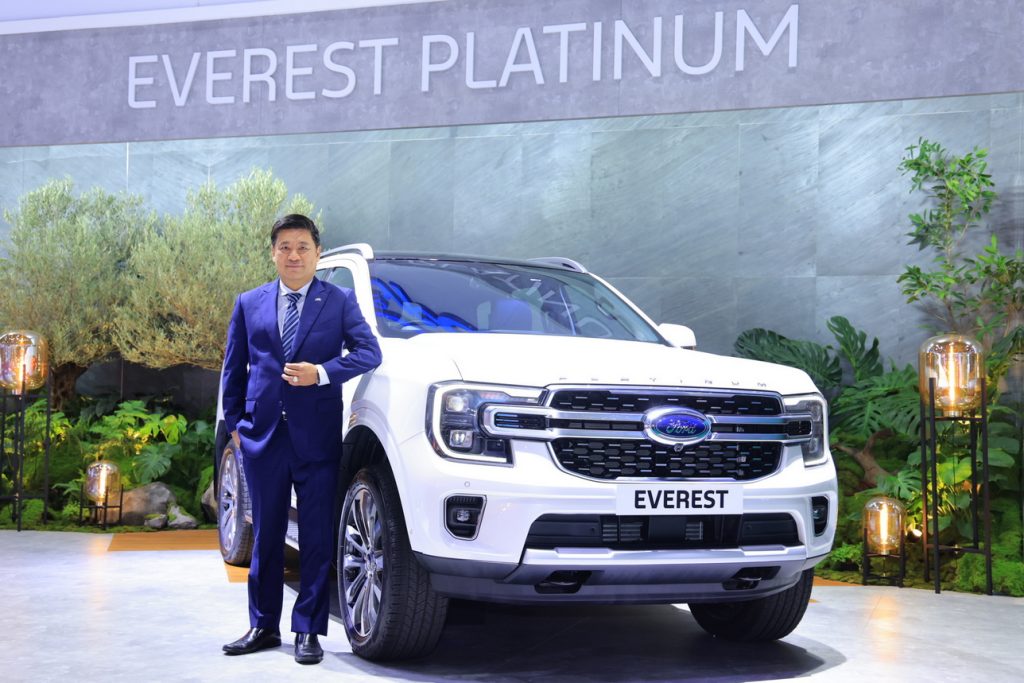
When Rattakarn Jutasen stepped into the role of Managing Director of Ford Sales Thailand in 2023, the appointment quietly rewrote the company’s local history.
Thaiautonews caught up with Rattakarn at Impact Arena and realized that since Ford established operations in the country, the automobile powerhouse continues a growing trend where leadership is passed to a Thai executive — one shaped not by rotational expatriate postings, but by decades of immersion in the domestic market.

It was a decision that spoke less of symbolism than of strategic maturity: an acknowledgment that Thailand had evolved from a regional outpost into a market capable of defining its own leadership.

In an industry long characterized by imported expertise and short-term executive tenures, Rattakarn’s ascent marked a subtle but decisive shift. Ford was no longer merely operating in Thailand; it was choosing to be led from within.
That distinction matters.
Shifting gears to Thailand’s automotive market — it is one of the most complex in Southeast Asia — price-sensitive yet brand-conscious, fiercely loyal and competitive, and shaped by deeply ingrained consumer pragmatism. To lead it effectively requires fluency not only in global corporate frameworks, but in the unspoken expectations of Thai buyers, dealers, partners and customers. Rattakarn brings precisely that dual literacy.
His professional foundations were laid at Assumption University (ABAC), where he completed a degree in Marketing before pursuing an MBA. Those years instilled in him a disciplined blend of analytical rigour and consumer psychology — an early understanding that purchasing decisions are rarely transactional, and almost never purely rational.

Colleagues from his formative career years describe him as deliberate rather than demonstrative, more inclined to ask why before deciding how. It is a trait that has endured. “Marketing is not about selling products,” he has often said internally. “It’s about understanding decisions.” That philosophy has followed him through every stage of his career, quietly shaping his leadership approach.
That said, he is unlike many automotive executives whose careers unfold within a single corporate ecosystem, Rattakarn’s trajectory is notably plural.
He began at Tripetch Isuzu Sales, Thailand’s pickup and commercial vehicle specialist. There, he gained firsthand exposure to dealer operations, fleet customers, and the everyday realities of Thai motorists — buyers less swayed by brand theater than by durability, resale value, and long-term cost of ownership.
From Isuzu, he moved to Esso, stepping beyond the automotive sphere into the energy sector. The transition broadened his commercial perspective, sharpening his understanding of large-scale operations, regulatory environments, and customer trust within a brand-driven yet commodity-based business. It also instilled a discipline around efficiency and long-term planning — traits that would later surface in his leadership at Ford.

His return to Ford came via an unexpected route: service operations. It is a detail that reveals much. Aftersales is where brand promises are tested, where loyalty is either reinforced or quietly eroded long after the showroom experience fades. For Rattakarn, time spent in service proved formative, offering a ground-level view of customer pain points, dealer economics, and operational complexity.
Few managing directors have spent meaningful time in aftersales. Fewer still cite it as a cornerstone of their leadership philosophy.
By the time Rattakarn was appointed Managing Director, Thailand’s automotive landscape was in flux. Electrification loomed on the horizon, emissions standards were tightening, consumer expectations were rising, and competition — particularly in the pickup-based SUV and PPV segments — was intensifying.

Ford itself was at a strategic inflection point. With the Ranger and Everest anchoring its portfolio, the brand needed not reinvention, but sharper execution — clearer positioning, stronger dealer alignment, and renewed confidence across the ownership journey.
Rattakarn’s mandate was never about dramatic upheaval. Instead, his focus has been on calibration — aligning global strategy with local reality, ensuring that product strength is matched by consistent experience, and that brand promise survives long after the purchase decision.
That philosophy is evident in Ford Thailand’s positioning today. The brand differentiates itself through robust performance, advanced safety technologies, and a reputation for toughness — particularly in its pickup lineup. But product alone is not enough. In Thailand, aftersales service is a decisive factor, and Ford has leaned into this with its “Always On” service concept, including online service booking via the Ford App, supported by highly trained technicians and continuous skills development.
Pricing discipline, thoughtful product planning, and value beyond headline cost are all part of a strategy designed to sustain trust rather than chase volume.

Those who work closely with Rattakarn often remark on what he does not do. He does not dominate meetings. He does not issue grand declarations. Instead, he listens — carefully, consistently, and often in unexpected places.
Dealer visits are frequent and sometimes unannounced. Conversations are informal, candid, and unfiltered. Meetings tend to end with questions rather than conclusions — as witnessed by Thaiautonews at last year’s annual press conference held at Ford’s training center.
This listening-first approach reflects his role as both interpreter and bridge. As a Thai executive leading a global brand, Rattakarn spends much of his time translating — global frameworks into local execution, and local feedback into global understanding.
“Global standards matter,” he has noted. “But execution is always local.” It is a philosophy that has allowed Ford Thailand to balance standardisation with sensitivity, avoiding the common pitfall of imposing global solutions on local realities.

Looking ahead, Ford Thailand’s marketing strategy is rooted in data, but animated by lifestyle insight. The objective is not simply to sell vehicles, but to enable customers to live the lives they choose — whether that means off-road adventure, family mobility, or professional reliability.
The approach rests on three pillars.
First, continuous product innovation informed by deep consumer insight, allowing vehicles to reflect individual identity and lifestyle.
Second, value beyond price — globally benchmarked quality supported by two manufacturing plants in Rayong that export to more than 100 countries.
And third, brand engagement — fueled by strong word-of-mouth from Ranger and Everest owners, immersive experiences like the Raptor Track Experience, and a growing sense of community around the brand.
Digital platforms play a central role. Thai consumers increasingly research online before visiting showrooms, adopting an online-to-offline mindset. Ford has aligned accordingly, integrating CRM systems, LINE Official Accounts, digital sales tools, and personalised communication across the customer journey. Post-purchase, the Ford App and LINE OA support service bookings, repair tracking, and loyalty programs — quietly extending the relationship beyond the sale.

Beyond sales, Thailand remains critical to Ford’s regional and global strategy. Since 1996, the company has invested more than THB 133.5 billion in the country. Its two Rayong plants — FTM and AAT — export vehicles to over 100 markets worldwide.
Equally strategic is aftersales capability. Ford’s upgraded parts distribution center in Samut Prakan now supplies over 60 countries, operating 24/7 with advanced global warehouse systems. It is the only facility of its kind in Asia-Pacific — a tangible signal of Thailand’s role as a regional logistics and manufacturing hub.
As electrification gathers pace globally with China spearheading this market trend, Ford Thailand continues to assess market readiness, infrastructure, and consumer demand. While the local lineup remains focused on internal combustion, Ford’s global investment in electrification — from hybrids to models like the Mustang Mach-E — signals a future transition guided by pragmatism rather than haste.

Thai consumers, after all, are keeping vehicles longer, weighing emerging technologies carefully, and prioritizing reliability. It is a market that rewards patience.
In many ways, Rattakarn Jutasen embodies that same restraint. He is not the most visible managing director Ford Thailand has known, nor the most outspoken. But in an era defined by complexity, his calm, systems-driven approach feels precisely calibrated.
On an ending note, Ford’s local managing director represents an act of confidence. For Rattakarn, it represents the culmination of a career spent understanding the business from the inside out—and the beginning of a chapter where local insight and global ambition finally meet on equal terms.
Rattakarn Jutasen 10 favorite things
1) Favorite gadget – Garmin Smart watch
2) Favorite movie – We Were Soldiers (2002 American war film by Randall Wallace and starring Mel Gibson)
3) Favorite restaurant – Smith & Rabbit Cuisine
4) Favorite destination – Petchabun province
5) Favorite human being – JFK (35th US President)
6) Favorite sport – Swimming
7) Favorite hobby – Reading
8) Favorite vice – Wine
9) Favorite memory – My first born
10) Favorite watch – IWC Mark 7